You don't have to paint every wall to transform a room. A single feature wall, a geometric pattern, a mural or a metallic stripe are the most elegant and economical ways to give your space character. In this guide we've gathered decorative wall painting ideas, how to apply each technique, and the tricks for a clean result.
What is decorative wall painting?
Rather than painting a whole wall a flat colour, decorative wall painting creates a visual focus with pattern, texture, a colour transition or a picture. Transforming a small area changes the mood of the whole room. Use a suitable wall paint for large areas; for patterns and decorative details, high-pigment acrylic paints do a flawless job.
10 decorative wall ideas
- A feature wall: Paint a single wall a dark or vivid colour.
- Geometric patterns: Triangles, blocks and mountain silhouettes with tape.
- Half wall (colour block): One colour on the bottom half of the wall, another on top.
- An ombré transition: A soft colour transition from light to dark.
- A stencilled pattern: A wallpaper effect from a repeating motif.
- A mural: A landscape, a botanical design or an abstract composition.
- A metallic stripe or accent: A luxurious touch in gold or copper.
- A polka dot pattern: Regular dots with a sponge.
- A children's room theme: Cloud, star and mountain motifs.
- A frame effect: The feel of a frame, created with painted rectangles.
What you'll need
- Acrylic paint for the decorative detail (a suitable wall paint for the base)
- A roller (for large areas) and a flat brush (for edges)
- A stencil brush set and stencils
- Masking tape (for crisp lines)
- A spirit level or ruler and a pencil (for alignment)
- Dust sheets or newspaper, and a stepladder
- Varnish (for areas that get touched often)
Step by step: a clean decorative wall
1. Prepare the wall
The wall must be clean, dry and smooth. Wipe away dust and grease, and fill and sand any holes or cracks. A smooth base means a crisp pattern.
2. Plan and mark out the design
Draw the pattern on paper first, then mark it lightly on the wall with a pencil and ruler. A spirit level is essential for geometric patterns; lines done by eye come out crooked.
3. Mask with tape
Use good-quality masking tape for crisp edges. A tip: once the tape is down, paint a thin line of the base colour along its edge, and apply the actual colour once that's dry — that way paint can't seep under the tape and the edges come out flawless.
4. Paint
Do the large areas with a roller and the edges and details with a brush. Work in thin coats; two thin coats are smoother than one thick one. If you're using a stencil, wipe the excess paint off the brush (less paint = a clean pattern with no bleeding).
5. Remove the tape at the right moment
Pull the tape away slowly at a 45-degree angle while the paint is still slightly damp, before it's fully dry; that way the paint film separates cleanly and the edges don't tear.
6. Protect it if needed
On walls that get touched or wiped often, such as a hallway or a child's room, a thin coat of varnish or a wipeable protective layer makes the pattern last.
Metallic and pearlescent touches
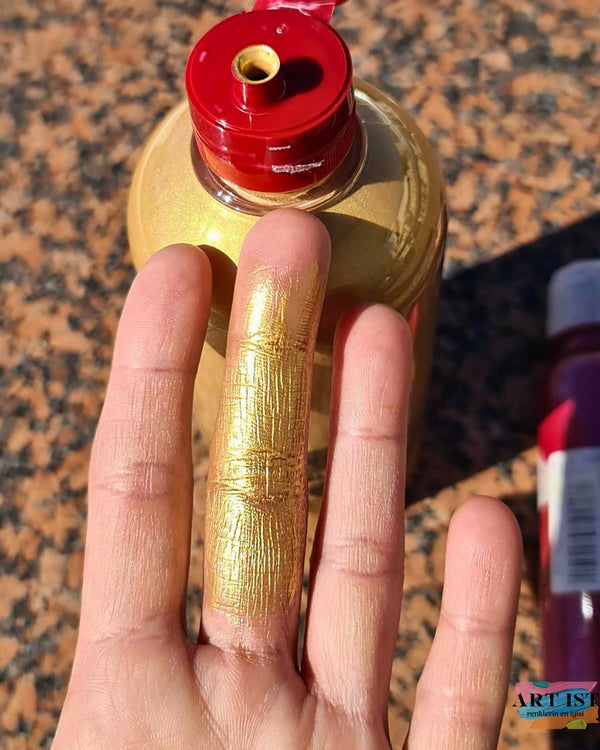
Metallic accents are the most striking form of decorative wall. A stripe, a frame or a dot pattern in gold, silver or copper makes a space look instantly luxurious. A metallic pattern over a dark base looks particularly dramatic.
Common mistakes in decorative wall painting
- Not preparing the wall: Roughness and dust spoil the pattern.
- Cheap or wrong tape: Paint seeps underneath and the edges go ragged.
- Aligning by eye: Geometric patterns come out crooked.
- Too much paint on the stencil: It bleeds under the motif and blurs.
- Removing the tape too late: Pulling it off once fully dry tears the paint.
Frequently asked questions
Can acrylic paint be used on walls?
Yes — it's excellent, particularly for decorative patterns, murals and accents. On very large areas, the most sensible approach is a suitable wall paint for the base and acrylic for the details, for reasons of cost.
Does the pattern wipe off the wall?
Acrylic is water-resistant once dry; in areas that get wiped often, applying a protective coat or varnish over the top improves durability.
I'm renting — can it be put back?
You can cover the decorative pattern later with the base colour, so choosing a light, neutral base makes reverting easy.
How do I stop the stencil moving?
Fix the stencil with masking tape or repositionable spray adhesive, and use little paint on the brush.
How do I make a metallic wall pattern shine more?
Apply it over a dark base and go over it with a thin coat of gloss varnish; it reflects more light.
One clever touch can transform an entire room. Whether it's a geometric pattern, a metallic stripe or a great big mural — your wall is your canvas. Choose your colours and brushes and put your signature on your home!