Fancy turning a boring T-shirt, an old denim jacket, a tote bag or a cushion cover into your own design? Painting on fabric is enormous fun and easier than you'd think. With the right preparation, acrylic paint gives vivid, lasting results on fabric. In this guide we take you step by step through how to paint on fabric, how to make the paint survive the wash, and the tricks for a professional look.
Can acrylic paint be used on fabric?
Yes — with one small secret. Neat acrylic paint can go hard and stiff on fabric and crack in the wash. The solution is to mix the paint with a textile medium (a fabric painting additive). The medium softens the paint, helps it work into the fabric and keeps it flexible. That way the paint moves with the fabric and doesn't come off in the wash.
Our auxiliary products include mediums that make your acrylic paint suitable for textiles.
Which fabrics can be painted?
- Cotton: The ideal fabric; it absorbs paint beautifully and durability is high.
- Linen and denim: Very suitable; natural fibres hold paint well.
- Tote bags, cushion covers: Usually cotton; they give a wonderful result.
- Synthetics (polyester): They take paint, but less well than natural fibres; medium and extra care are needed.
For the most reliable result, start with 100% cotton or other natural-fibre fabrics.
What you'll need
- Acrylic paint (high pigment for vivid colours)
- Textile medium (fabric additive)
- Soft brushes, a sponge or a stencil brush
- Card or plastic (placed between the layers to stop paint going through)
- A stencil and tape (for patterns)
- An iron (to set the paint)
Step by step: how to paint on fabric
1. Wash and iron the fabric
New fabric carries a finish (factory chemicals) that stops paint gripping. Wash the fabric first and dry it, then iron it for a smooth surface. This step is critical for durability.
2. Put a barrier between the layers
On double-layered items such as T-shirts and bags, place card or plastic between the layers so the paint doesn't go through to the back. It also gives you a flat, taut working surface.
3. Mix the paint with the medium
Mix the acrylic paint with textile medium in the ratio the manufacturer recommends (usually a paint-heavy mix). This step keeps the paint soft and flexible on the fabric. Don't over-thin it; it should keep its consistency.
4. Apply the paint
Apply your design with a brush, sponge or stencil. Work in thin coats; a single thick coat goes stiff. One coat may be enough on light fabric; for a light colour on dark fabric, a white coat first will make the colour sing.
5. Leave it to dry
Leave the paint to dry completely for at least 24 hours. Don't rush; damp paint won't set and will wash out.
6. Set it with heat (iron)
The last and most important step for durability. Place a thin cloth (or baking parchment) over the painted area and iron it for a few minutes on a medium-high, steam-free setting. The heat bonds the paint permanently to the fabric. After this step, the paint is washable.
Washing and care
- Wait at least 72 hours before the first wash.
- Wash inside out, in cold water, on a gentle cycle.
- Avoid bleach and harsh detergents.
- Hand-wash where you can; it extends the life of painted textiles.
- Don't iron the painted area directly (put a cloth over it).
Creative project ideas
- Hand lettering or a minimal design on a plain T-shirt
- Leaf printing on a tote bag (paint a leaf and press it on like a stamp)
- A back design on an old denim jacket
- Geometric stencil patterns on cushion covers
- Hand and finger printing with a child (water-based, safe)
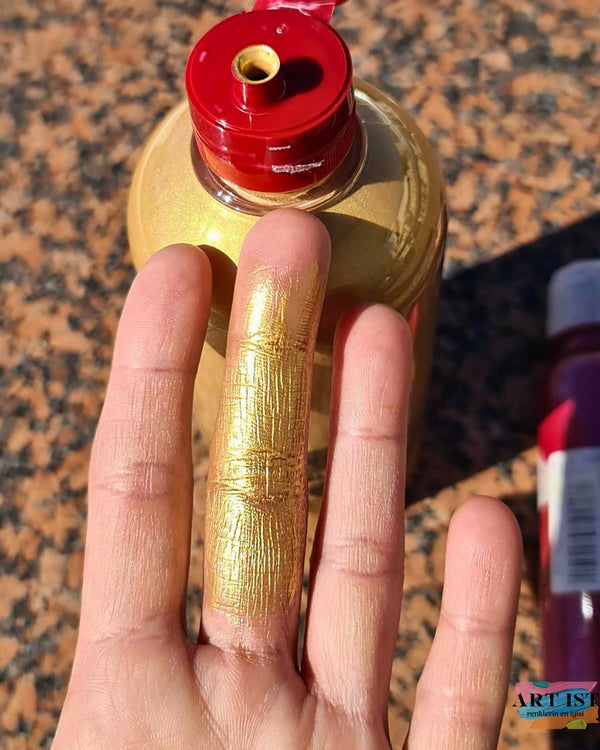
Take a look at our high-pigment acrylic paints for vivid colours; for a metallic shimmer, metallic tones look very smart on fabric too.
Common mistakes when painting fabric
- Not pre-washing the fabric: The finish repels the paint.
- Not using a medium: The paint goes hard and cracks.
- Not setting it with heat: It washes out the first time.
- Thick coats: The fabric goes stiff and heavy.
- No barrier between the layers: The paint goes through to the back.
Frequently asked questions
Does acrylic paint last on fabric?
Yes — mixed with a medium and set with heat (an iron), it's washable and long-lasting.
Is textile medium essential?
Strongly recommended. Without it, acrylic goes hard on fabric and can crack; the medium provides softness and flexibility.
Can I machine-wash painted fabric?
After setting, yes — but inside out, cold and on a gentle cycle. Hand-washing extends its life further.
How do I get a light colour onto dark fabric?
Apply a white or primer coat first, then the actual colour once it's dry; that way the colour comes out vivid.
Does paint make fabric stiff?
With thin coats and a medium, stiffness is minimal. Thick coats and applying it without a medium are the main causes of that heavy feel.
Painting fabric is the most enjoyable way to add a touch that's entirely your own to your wardrobe and your home textiles. Proper preparation, a medium and setting with an iron — that's the whole secret of durability. Choose your colours and turn ordinary fabric into a work of art!